


Throughout human history, societies have developed manufacturing techniques that allowed them to produce increasingly complex tools and components, each innovation building upon previous knowledge whilst opening new possibilities for technological advancement. MIM manufacturing, or Metal Injection Moulding, represents one such evolutionary leap in our ability to fabricate intricate metal parts, combining principles borrowed from ceramics processing with modern metallurgy to create components that would have been prohibitively expensive or simply impossible to produce through traditional methods. This manufacturing process emerged in the 1970s and has since spread across industrial nations, finding particular success in regions where high-value manufacturing clusters have formed, much as certain technologies have historically flourished in geographical areas with the right combination of expertise, infrastructure, and market access.
The Technological Convergence Behind the Process
MIM manufacturing arose from the convergence of three distinct technological traditions: powder metallurgy, which dates back millennia to ancient metalworking cultures; plastic injection moulding, perfected during the twentieth century; and ceramic processing techniques that taught engineers how to bind particles together temporarily before permanent consolidation. This synthesis demonstrates a pattern observed throughout technological history, where breakthrough innovations often result not from entirely novel discoveries but from creative combinations of existing knowledge applied in new contexts.
The process works through a carefully orchestrated sequence. Metal powder, ground to particles measuring between five and twenty micrometres in diameter, gets mixed with thermoplastic and wax binders. This feedstock then flows into precision moulds under heat and pressure, much like plastic injection moulding. The resulting green parts undergo debinding to remove most binders, followed by high-temperature sintering that fuses the metal particles whilst causing predictable shrinkage. The final components achieve densities approaching 97 to 99 percent of wrought metal properties.
Geographical Patterns in Modern Manufacturing
Singapore’s MIM manufacturing sector illustrates how small, resource-poor nations can thrive in high-value manufacturing niches. Despite lacking natural metal resources and constrained by limited land area, Singapore has built significant capacity in MIM production for medical devices, electronics, and precision industrial components. This success parallels historical patterns where trading centres developed specialised manufacturing capabilities, leveraging their position in global networks rather than relying on local raw materials. The country’s investment in technical education, quality infrastructure, and regulatory frameworks aligned with international standards has created conditions favouring advanced manufacturing processes.
The global distribution of MIM capabilities shows concentration in regions with established manufacturing ecosystems. Facilities require not just equipment but supporting infrastructure: reliable power supplies, skilled technicians, quality control laboratories, and proximity to customer industries. These requirements create natural clustering effects, similar to how certain industries historically concentrated in specific regions due to combinations of favourable conditions.
Industrial Applications and Material Choices
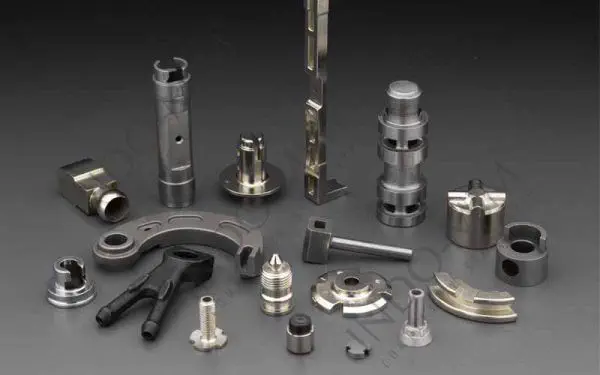
Industrial applications of MIM manufacturing span diverse sectors, each exploiting different advantages of the process:
- Automotive components including fuel injection systems, turbocharger parts, and transmission elements where complex internal geometries improve performance
- Medical and surgical instruments requiring biocompatible materials like 316L stainless steel with intricate features impossible to machine economically
- Aerospace components where weight reduction through optimised geometry justifies premium materials like titanium alloys
- Consumer electronics housings and internal mechanisms demanding precise tolerances in compact forms
- Industrial tooling and equipment components needing wear resistance combined with complex shapes
- Firearms components where strength requirements meet geometric complexity
Material selection drives application possibilities. Stainless steels dominate due to their corrosion resistance and biocompatibility. Low alloy steels offer strength at lower cost. Titanium alloys provide exceptional strength-to-weight ratios. Tungsten-based materials deliver extreme density and hardness. Each material requires specific processing parameters developed through systematic experimentation, knowledge that represents accumulated learning similar to how agricultural societies gradually optimised crop cultivation techniques for local conditions.
Economic Drivers and Constraints
The economics of MIM manufacturing follow predictable patterns related to volume and complexity. Initial tooling costs, typically ranging from fifteen thousand to forty thousand pounds for complex moulds, must be amortised across production runs. Break-even points generally occur at production volumes exceeding ten thousand units, though this varies with part complexity and available alternatives.
The process demonstrates comparative advantage most clearly for parts featuring:
- Complex three-dimensional geometries with undercuts or internal features
- Tight tolerances requiring minimal secondary machining
- Material compositions difficult to machine conventionally
- Production volumes justifying tooling investment
- Size ranges between 0.1 and 250 grammes where the process operates most efficiently
These constraints create natural application boundaries. Very large parts exceed practical sintering furnace capacities. Very small volumes cannot justify tooling costs. Simple geometries may be cheaper to machine or cast. Understanding these boundaries allows engineers to deploy MIM manufacturing where it offers genuine advantages rather than forcing it into inappropriate applications.
Trajectory of Technological Development
The continuing evolution of MIM manufacturing follows patterns observed in other maturing technologies. Process improvements incrementally expand capabilities. Binder systems have evolved from early paraffin-based formulations to sophisticated polymer systems allowing faster debinding. Furnace technology has advanced, improving atmosphere control and energy efficiency. Computer simulation now predicts shrinkage and distortion, reducing development iterations. These cumulative improvements mirror how established technologies gradually refine their capabilities through systematic problem-solving.
Looking forward, MIM manufacturing faces both opportunities and challenges. Growing demand for miniaturised components in electronics and medical devices favours the process. Sustainability concerns drive research into more environmentally friendly binders and energy-efficient sintering. Competition from additive manufacturing threatens some applications whilst opening others through hybrid approaches. The ultimate trajectory will depend on how these competing factors resolve, much as the fate of historical technologies depended on their ability to adapt to changing economic and social conditions. What remains certain is that MIM manufacturing will continue serving industrial applications where its unique combination of geometric complexity, material properties, and economic scalability provides advantages that alternative processes cannot match.